Why Fragmentation Is LatAm's Biggest Investment Signal

Today, Varys Capital and Verda Ventures published a very interesting report: LATAM: Beyond the Acronym, a 70-page analysis of technology and financial investment opportunities in the region. The report centers on a key point: treating Latin America as a single market is a mistake, and the region's fragmentation is, in itself, an investment signal.
This analysis aligns with many of the findings we have made at Cuantico VP over the past few months. That is why we wanted to read it in light of data from our VC Monitor, which between January and August of this year has recorded 270 funding rounds totaling nearly USD 9.86 billion, as well as 130 M&A transactions.
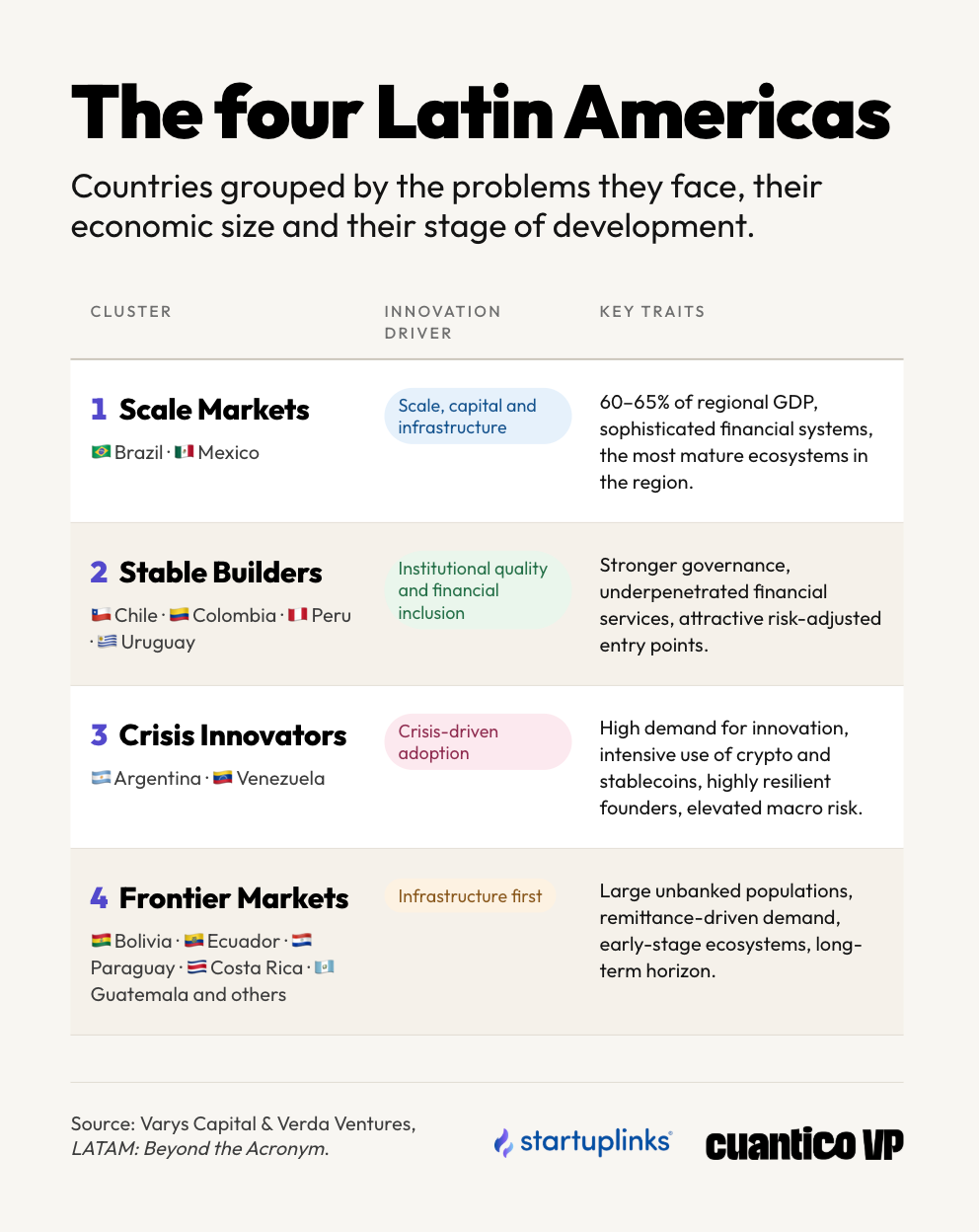
The Four Latin Americas Framework
From our perspective, one of the most valuable contributions of the report is its four-cluster framework. It groups countries not by geography, but by the type of problems they face, their economic size, and their stage of development. We find it a coherent framework because it explains something we see every day: two neighboring countries may need completely different solutions.
| Cluster | Countries | What drives innovation | Key traits |
|---|---|---|---|
| 1. Scale Markets | Brazil and Mexico | Scale, capital, and infrastructure | 60–65% of regional GDP, sophisticated financial systems, the most mature ecosystems in the region. |
| 2. Stable Builders | Chile, Colombia, Peru, and Uruguay | Institutional quality and financial inclusion | Stronger governance, underpenetrated financial services, attractive risk-adjusted entry points. |
| 3. Crisis Innovators | Argentina and Venezuela | Crisis-driven adoption | High demand for innovation, intensive use of crypto and stablecoins, highly resilient founders, elevated macro risk. |
| 4. Frontier Markets | Bolivia, Ecuador, Paraguay, Costa Rica, Guatemala, and others | Infrastructure first | Large unbanked populations, remittance-driven demand, early-stage ecosystems, long-term horizon. |
The power of the framework is that it changes the question. It is no longer about whether Latin America is attractive, but about which market, which problem, and which structural conditions create the opportunity. A neobank makes sense in Brazil because of scale; a digital-dollar wallet makes sense in Argentina because of survival and macro risk; a mobile payments network makes sense in Central America because the underlying infrastructure does not yet exist.
Capital Remains Concentrated in a Single Cluster
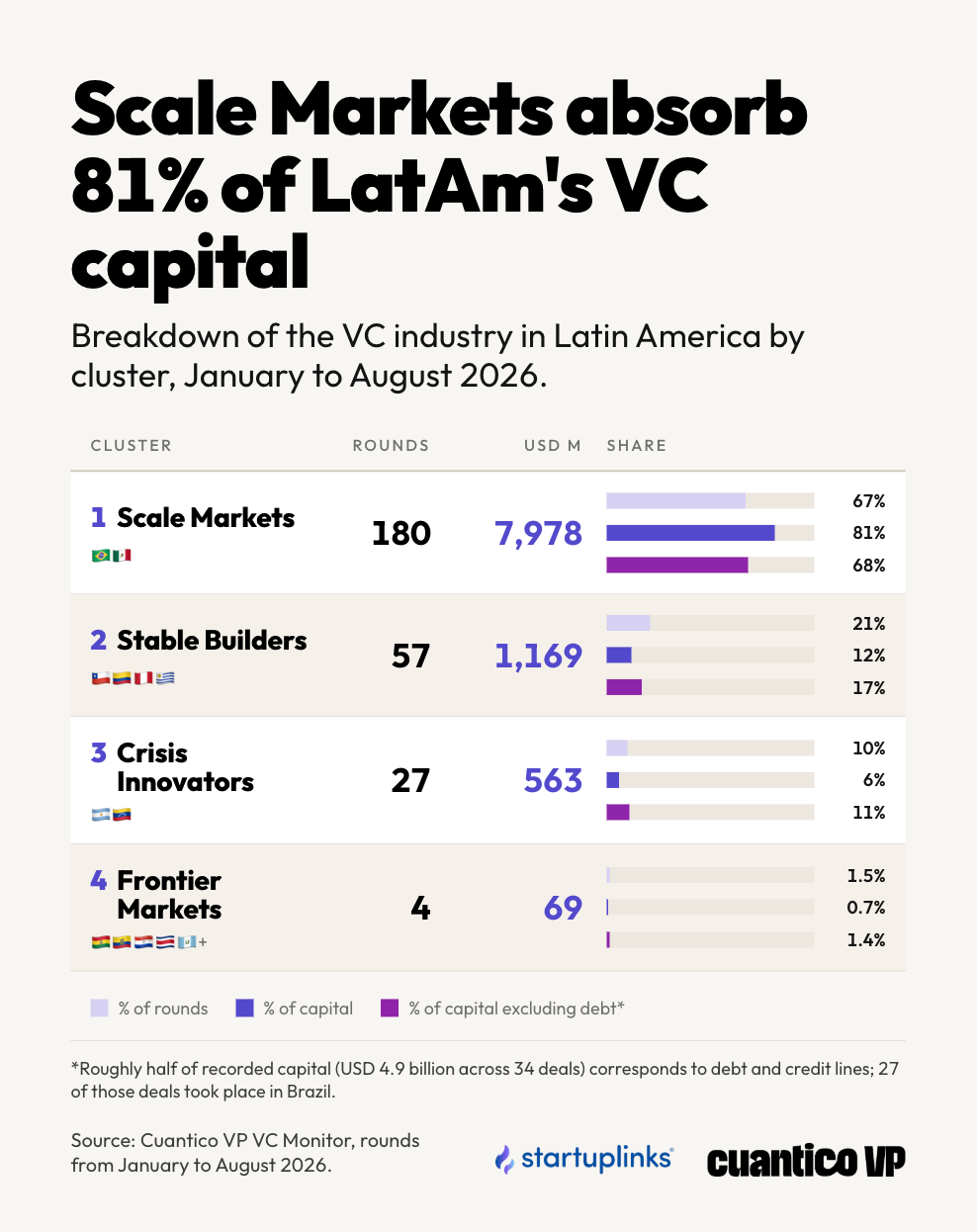
Our 2025 data showed that Brazil and Mexico absorbed 78.5% of regional venture capital. In 2026, we see that the pattern has not changed: the Scale Markets (Mexico and Brazil) account for over 60% of rounds and over 80% of capital raised.
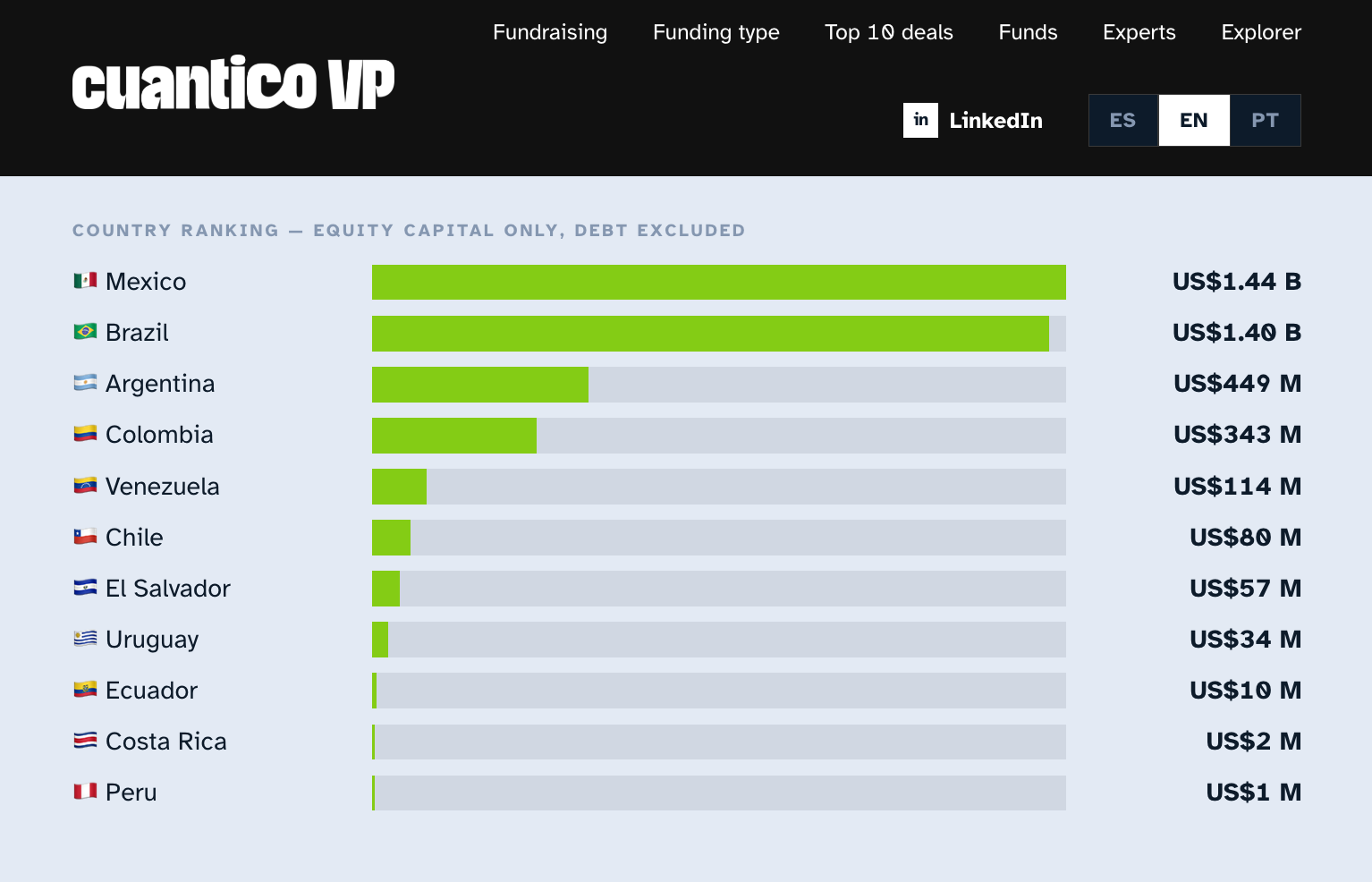
Breakdown of the VC industry in Latin America, January to August 2026
| Cluster | Rounds | % of rounds | Capital (USD M) | % of capital | % of capital excluding debt |
|---|---|---|---|---|---|
| 1. Scale Markets | 180 | 67% | 7,978 | 81% | 68% |
| 2. Stable Builders | 57 | 21% | 1,169 | 12% | 17% |
| 3. Crisis Innovators | 27 | 10% | 563 | 6% | 11% |
| 4. Frontier Markets | 4 | 1.5% | 69 | 0.7% | 1.4% |
Source: VC Monitor, rounds from January to August 2026. Cuantico VP
There is an important nuance: roughly half of the recorded capital (USD 4.9 billion across 34 deals) corresponds to debt and credit lines, and 27 of those deals took place in Brazil, such as CloudWalk's USD 1.1 billion facility. Looking only at equity capital, the Scale Markets' share drops to 68%, and the share of the other three clusters nearly doubles. The concentration is real, but the scale markets also have access to credit instruments that the rest of the region does not yet have.
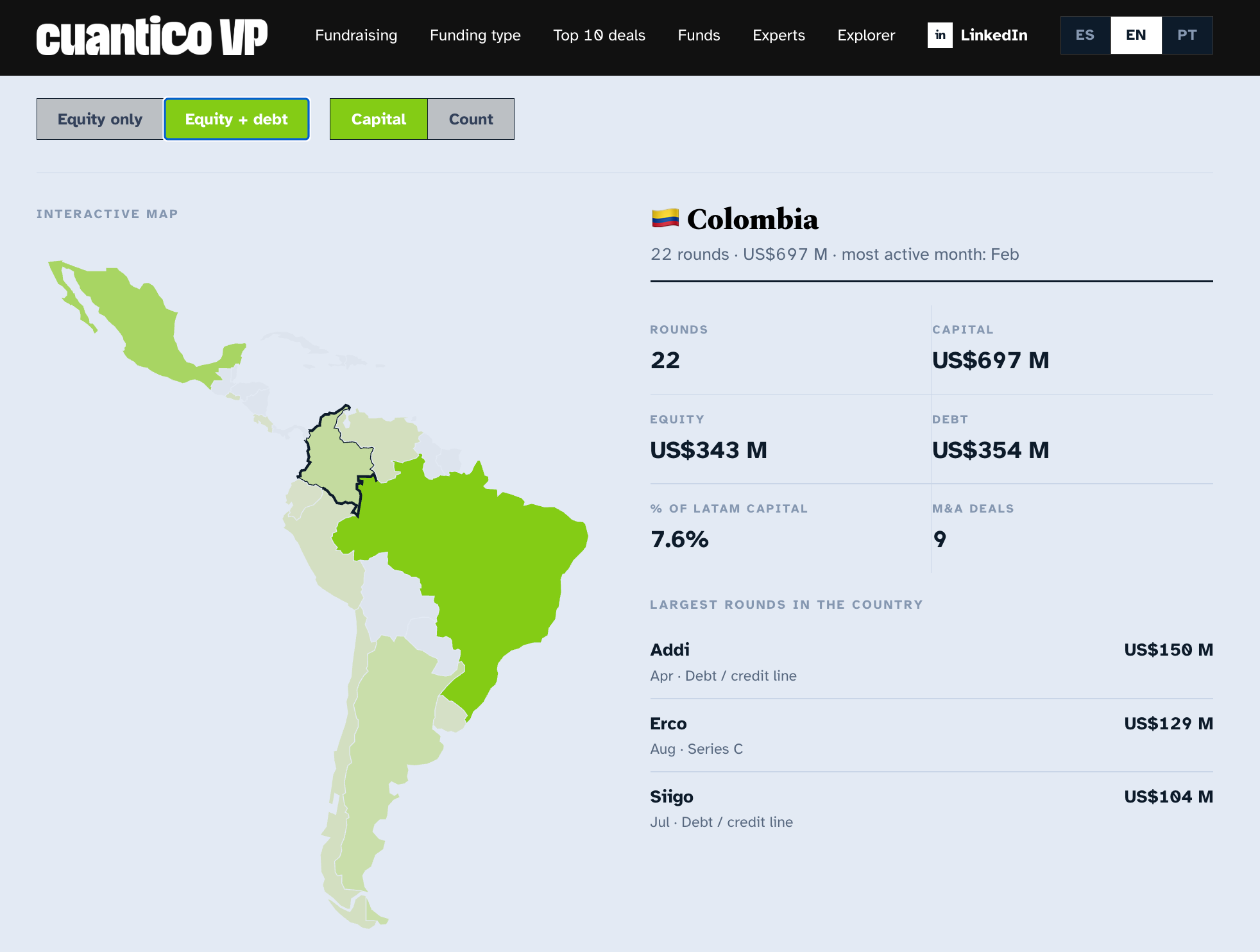
The Stable Builders deserve special attention. So far in 2026, Colombia has raised nearly USD 700 million, with deals such as Addi, Erco, Siigo, and Yuno. Uruguay is also growing in activity and number of rounds, almost all at early stages. This is exactly the profile the report describes: growing ecosystems with attractive entry points.
At the opposite end, the Frontier Markets have seen fewer than 10 rounds in the first eight months of the year. It is the clearest gap between need and capital in the entire region.
Stablecoins: Blockchain's First True Product-Market Fit in the Region
According to the report, of the USD 730 billion in crypto value Latin America received in 2025, USD 324 billion moved through stablecoins, and 71% of institutions in the region already use them for cross-border payments. The authors describe them as the base layer of a new financial architecture: embedded finance, real-world asset tokenization, capital markets, credit, and treasury management are all being built on top of them.
Our VC Monitor confirms this from the capital side. Between January and August, we recorded at least 13 rounds in stablecoin, crypto, and tokenization infrastructure, totaling nearly USD 200 million:
- Cross-border payments infrastructure: Trace Finance (USD 32M, with CoinFund, Coinbase Ventures, and Haun Ventures), VelaFi (USD 20M Series B), UnblockPay (USD 4.5M), and Oxus Finance (USD 2.4M).
- Local stablecoins and tokenization: Avenia, issuer of the real-backed stablecoin BRLA (USD 17M Series A), and Mercado Bitcoin (USD 20M, led by Tether).
- Digital-dollar wallets: Belo in Argentina (USD 14M Series A, led by Tether) and El Dorado in Venezuela (USD 9M Series A, led by Paradigm, with Coinbase Ventures and Verda Ventures itself).
These details confirm the logic of the clusters. In Brazil and Mexico, stablecoins are being funded as B2B payments and liquidity infrastructure. In Argentina and Venezuela, they are being funded as a consumer product: a way to protect savings from unstable currencies.
What We See at Cuantico VP
When we cross-reference our data with the four Latin Americas framework, each cluster shows its own signature:
- Scale Markets: they stand out for their volume and sophistication. Beyond large rounds such as Clip (USD 500M) and Plata (USD 405M Series C), they are the only markets where structured credit is already financing growth at scale. They also account for more than 60% of the M&A transactions we have tracked, a sign of a market that is already consolidating.
- Stable Builders: growing capital with an attractive risk-return profile. Colombia is consolidating its position as the region's third hub, while Chile and Uruguay generate a steady flow of seed and pre-seed rounds.
- Crisis Innovators: severe problems that produce large companies. Argentina has recorded more than 20 rounds, including Ualá (USD 195M), Humand (USD 66M), and Pomelo (USD 55M), while in Venezuela, Cashea raised a USD 100M Series B.
- Frontier Markets: fewer than 10 rounds so far this year in a cluster of at least 10 countries. The need is enormous and capital is nearly nonexistent, which confirms the long-term horizon the report outlines.
The report also documents that VC-backed startup exits reached USD 4.9 billion in 2025, a 172% increase, a figure we presented earlier this year in our Latin America VC Report. That liquidity is shaping a new generation of founders and investors, something we also see reflected in this year's M&A momentum. It is undoubtedly a trend that will keep growing, especially with the emergence of a secondaries market in the region.
Which Cluster and Which Problem
The report's conclusion aligns with our view: the investors with the most durable returns in Latin America have been clear about which cluster they are playing in and which specific problem their companies are solving. The region supports several investment theses at once, and each requires its own capital, time horizon, and operating approach.
At Cuantico VP, we will continue to track how capital moves across these "Four Latin Americas" through our Monitors. We highly recommend reading the full report: LATAM: Beyond the Acronym.
Jose Kont
Partner at Cuantico VP