The VC Mirage in Mexico: Record Capital, but Fewer Startups

There is a topic that should be on the agenda of every investor, fund, and founder in the region, and yet it keeps slipping past almost unnoticed under the optimistic headlines: the extreme concentration of venture capital in Latin America. This is not a technical detail for data analysts. It is an early warning signal about the structural health of the entire ecosystem, and it deserves attention now, not once the problem becomes irreversible. When two or three giant checks explain most of the capital reported in a market, the headline stops reflecting the reality of the startups actually being born, and starts hiding it. That is exactly what is happening today, and the consequences are not abstract: they determine which startups survive, which sectors go unfunded, and which cities in the region will keep producing founders five years from now.
In H1 2026, US venture capital posted a record half-year, but the number hides an uncomfortable truth: four giant AI financings explain most of the volume. Latin America is replicating this pattern, but with a critical difference. Its megadeals are not born out of a technological revolution like AI, but out of mature companies, mostly in fintech, consolidating positions they built a couple of years ago.
The Mexico case: US$800M that are, in reality, three deals
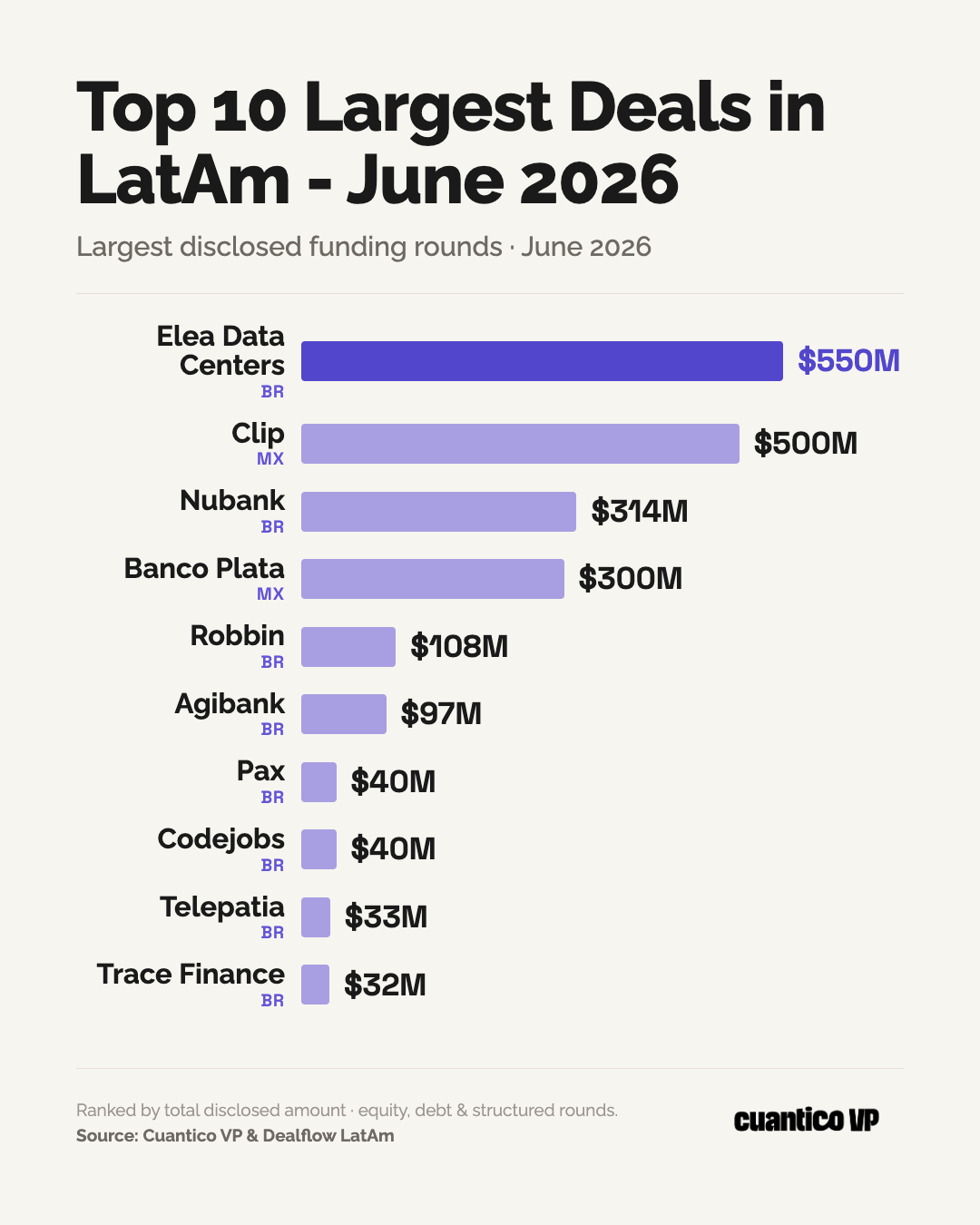
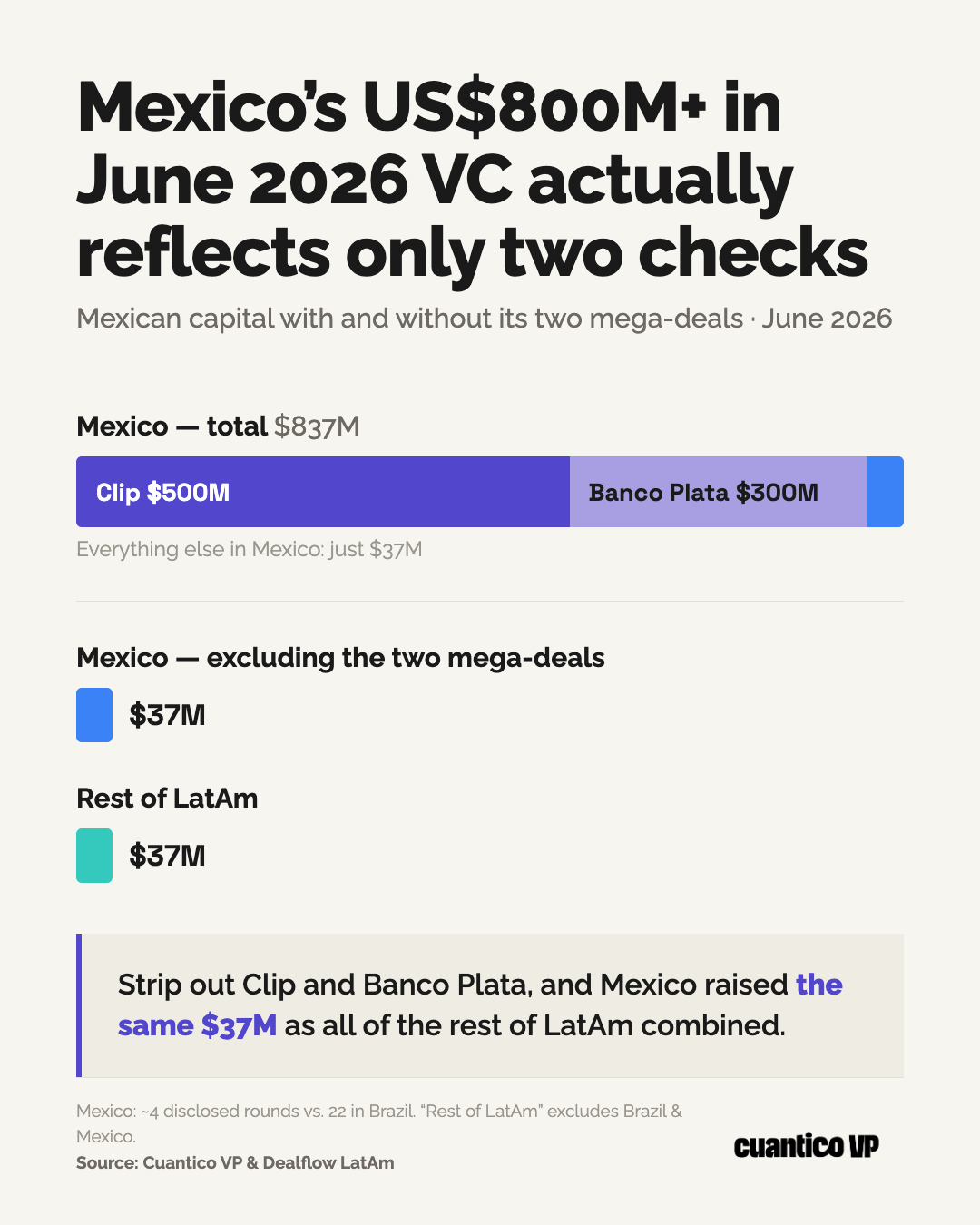
June 2026 figures for Mexico tell a perfect story about the statistical illusion of concentrated venture capital. Headlines say Mexican startups raised more than US$800 million during the month. The reality, once you look beneath the number, is far more sober: Clip closed a US$500 million round, and Banco Plata expanded its credit line by an additional US$300 million. Two checks. One month. And what is left for the rest of the Mexican ecosystem is barely US$37 million.
The detail that fully illustrates the distortion is that this same amount, US$37 million, is exactly what the rest of Latin America (excluding Brazil and Mexico) raised during the same period. Mexico, without its two megadeals, does not outraise much smaller markets in early-stage capital.
The regional picture: more capital, fewer startups
According to the report we published this year, Latin America's VC ecosystem showed an apparent recovery in 2025: more total capital than the year before, but the number of rounds hit its lowest level since 2018. Average ticket size grew, confirming that more money is moving toward fewer startups with proven traction, not toward a broader, more diverse ecosystem. Brazil and Mexico accounted for 70%+ of regional investment, and within those countries, capital clustered around fintechs with already-proven models.
The real problem: the pipeline is running dry
This is where the medium- and long-term systemic risk lies. The ecosystem is not just concentrating at the top of the funnel, Series B, Series C, and megadeals, the very base of the funnel is collapsing. According to the study we published this year, pre-seed funding fell in 2025, and the number of deals at that stage dropped nearly 40% year over year, hitting its lowest levels across the entire period analyzed. Seed funding also showed a sustained decline in round volume, despite a slight recovery in dollar amounts. And 70%+ of investors identified the lack of exits as their top risk for the next 18 months.
The structural consequence is direct. If early-stage startups are not funded today, there will be no candidates for Series A in 18 to 24 months, or for Series B in 36 to 48 months. The pipeline is not a faucet you can turn on and off at will: it is a sequential process where each stage feeds the next, and a gap at the base takes years to show up at the top, but by the time it does, it is already too late to fix.
The long-term risks for the ecosystem
Extreme capital concentration is not just a statistical distortion, it carries concrete consequences:
- Sectoral homogenization. When fintech captures most of the capital through a fraction of the deals, sectors like agtech, healthtech, climatetech, and edtech are left starved of oxygen. The ecosystem loses diversity, and with it, resilience against sector-specific shocks.
- Single-city ecosystems. Geographic concentration in São Paulo and Mexico City keeps deepening. Emerging ecosystems, Bogotá, Lima, Santiago, Guatemala City, fail to retain founding talent or attract enough capital to build local critical mass.
- Dependence on foreign capital. Rounds like Clip's and Banco Plata's are financed mostly by international institutional capital. When global macro conditions shift, that capital pulls out faster than it arrived. Ecosystems with a thin local capital base are the first to suffer.
- The "valley of death" widens. With fewer active early-stage funds in the region, the gap between pre-seed and an institutional Series A round becomes harder and harder to cross. Many promising startups die in that stretch, not for lack of a good idea, but for lack of bridge capital.
- A false signal for the ecosystem. Headlines like "VC breaks record in 2026" create a distorted perception of the market's real state. Founders who read that number without context may overestimate how much capital is actually available for their own rounds, misjudge their timelines, and make strategic decisions based on a reality that does not exist for 95% of the market.
What the data actually says
Venture capital in Latin America is showing maturity at its top layer: bigger checks, more discipline, more focus on unit economics. But the base keeps narrowing. A healthy ecosystem needs at least three things: large rounds that build confidence, exits that prove returns, and a steady flow of early-stage capital that renews the innovation pipeline.
Today, the Latin American ecosystem has the first sporadically, and the second and third in sustained decline. Two megadeals in Mexico in a single month are not a sign of broad ecosystem health. They are proof that capital knows exactly where it is going, and in doing so, exposes everything it fails to reach.