The Rise of LatAm’s Mega-Rounds: What Decade, Ábaco, Humand, and Cashea Signal for VC
An analysis by Cuantico VP of four record-breaking rounds in 2026, contrasted with a decade of regional fundraising and valuation medians.

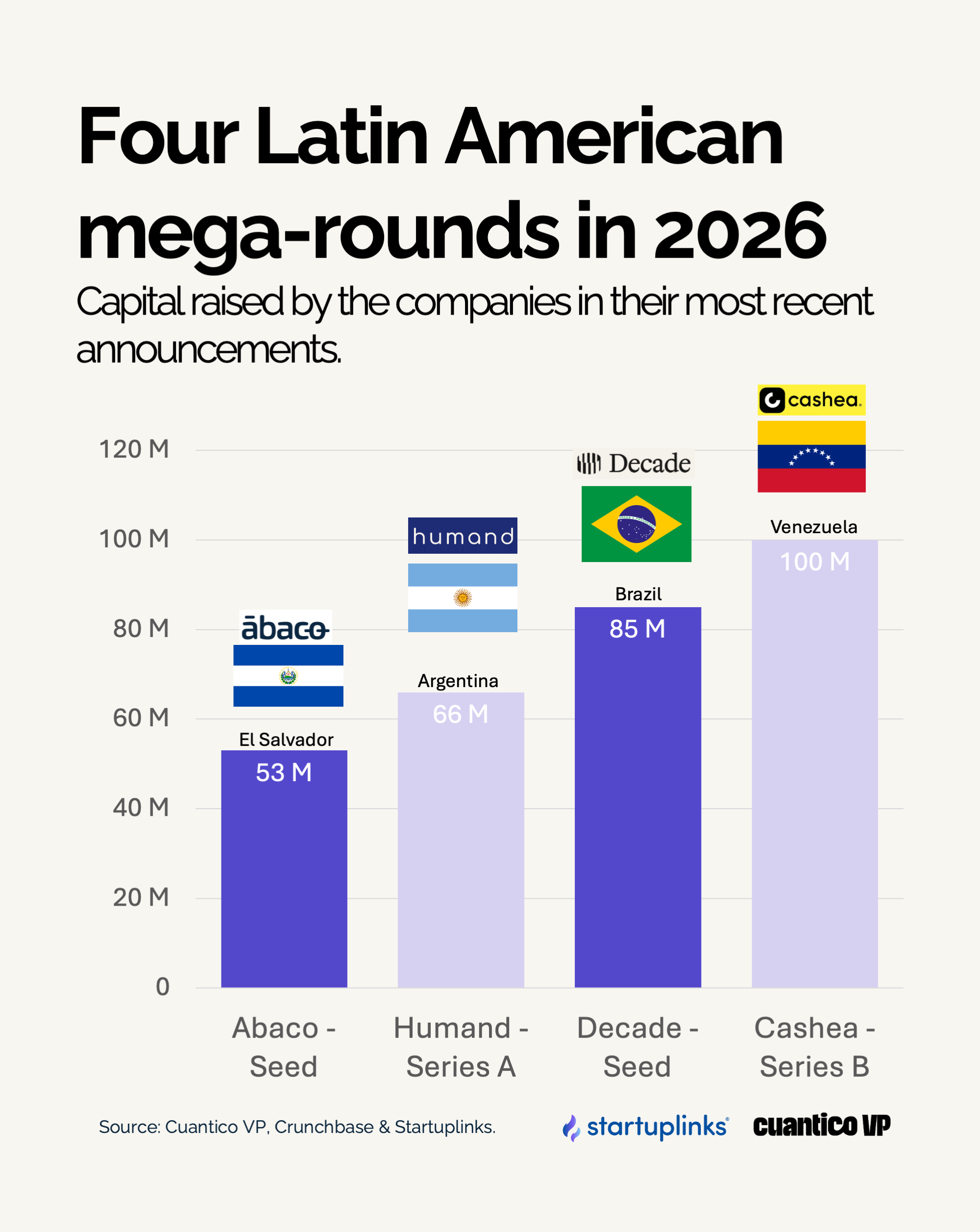
The year 2026 is giving Latin America something it has rarely seen: nine-figure checks before a business model has been fully proven, or in markets that international capital had avoided for years. In less than six months, four companies broke regional records without fitting the classic mold of a “startup that scales round after round.” Decade raised the largest seed round ever recorded in the region in São Paulo. Humand, from Argentina, closed the largest Series A in LatAm’s history. Ábaco, based in El Salvador, closed the largest Seed round ever recorded by a Central American fintech. And Cashea, in Venezuela, secured the largest investment ever received by a startup in the country, in a market international funds had avoided for more than a decade.
None of these is a “typical” mega-round: one came before the public launch, another rewarded a reputation built outside the company itself, and one bet on a country facing sanctions and a prolonged crisis. To understand just how unusual they are, they must be compared with ten years of data that Cuantico VP has compiled on regional fundraising and pre-money valuation medians.
Four rounds, four different rationales
Decade (Brazil) — US$85M in a seed round without a public product. Founded by Vitor Olivier, Nubank’s former CTO, and Felipe Meneses, founder of Hyperplane, Decade combines AI with human advisors to democratize wealth management in a country where only 33% of the population invests and just 7% could fund retirement through savings. Greenoaks, Benchmark, and Diffusion committed the capital in September 2025, months before the company emerged from stealth; at the time of the announcement, the product remained in closed beta with a waitlist.
Humand (Argentina) — US$66M in the largest Series A in regional history. Kaszek and Goodwater Capital led the round for this AI platform designed for “deskless” workers, a segment representing 80% of the workforce but one that corporate software rarely serves. With more than 1.6 million users across 1,500 companies in 51 countries, the company reached an estimated post-money valuation of US$225 million, according to market sources cited by Forbes Argentina.
Ábaco (El Salvador) — US$53M in Central America’s largest fintech seed round. Founded in 2023 by Salvadorans Alejandro McCormack, Carlos Villalobos, and Moisés Hasbún, Ábaco uses artificial intelligence and automation to help small and medium-sized businesses convert unpaid invoices into cash in under 24 hours. Since launch, the company has raised more than US$60M in total, surpassed US$100M in originated credit, and completed more than 25,000 disbursements. The transaction includes a financing facility led by Accial Capital, alongside backing from several regional funds.
Cashea (Venezuela) — US$100M split across Series A and B rounds in a single year. The buy now, pay later fintech, founded in 2022 by Pedro Vallenilla and his team, closed a US$40M Series A in March—US$20M in equity led by Spice Expeditions and US$20M in debt from Architect Capital—and a US$60M Series B in June, announced jointly through June, led by FinSight Ventures, with Endeavor Catalyst, Plug and Play, and U.S. endowments participating. With more than 10 million user accounts—more than half of Venezuela’s adult population—and 40,000 affiliated merchants, Cashea surpassed the previous record held by Yummy and became the largest round ever raised by a Venezuelan startup. Its founders say the capital will be invested entirely in the country.
The contrast with a decade of medians
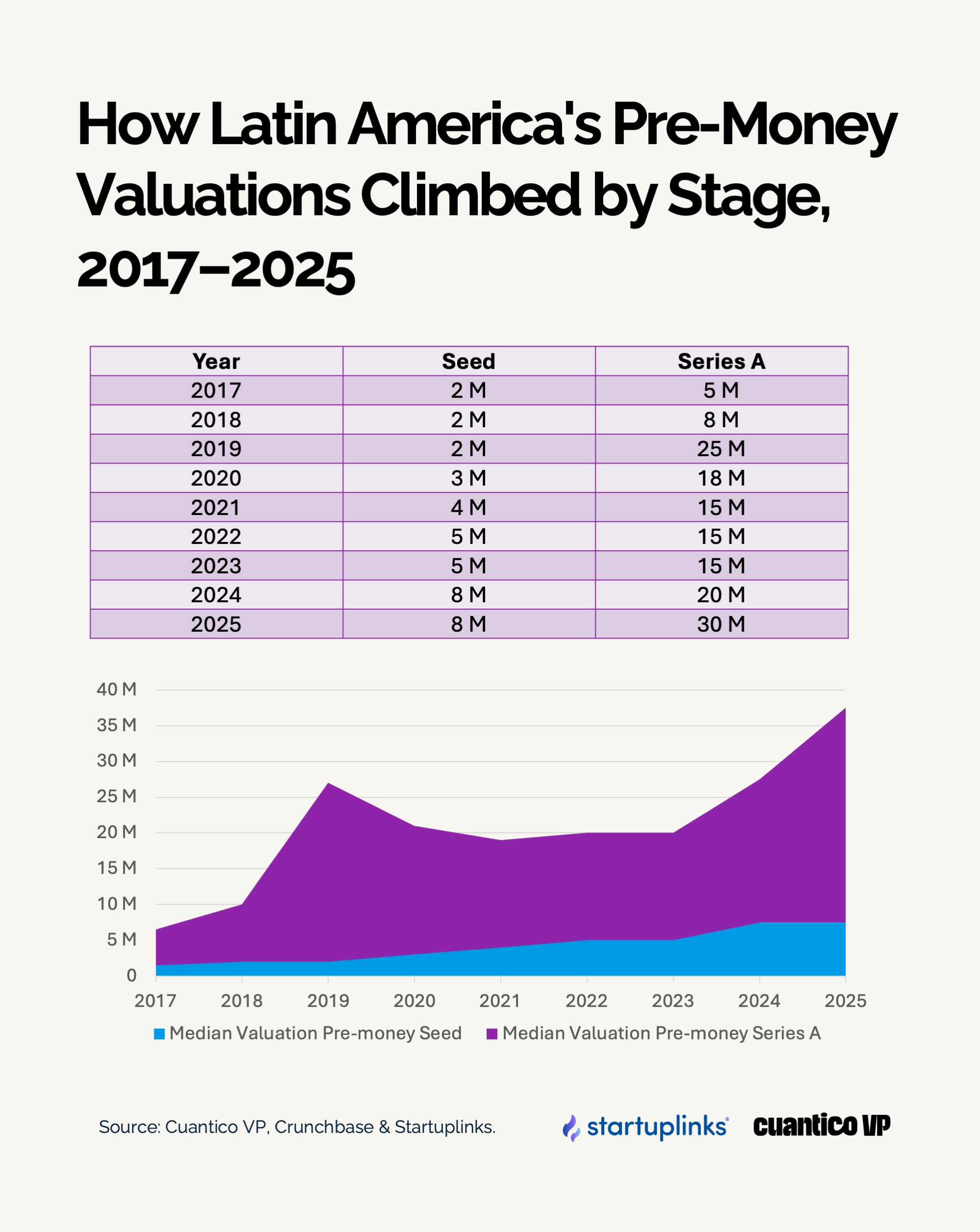
Since 2017, Cuantico VP has tracked the annual median capital raised and pre-money valuation for pre-seed, seed, and Series A stages in Latin America. Compared with that historical series, these four rounds stop looking merely “large” and emerge as statistically extraordinary.
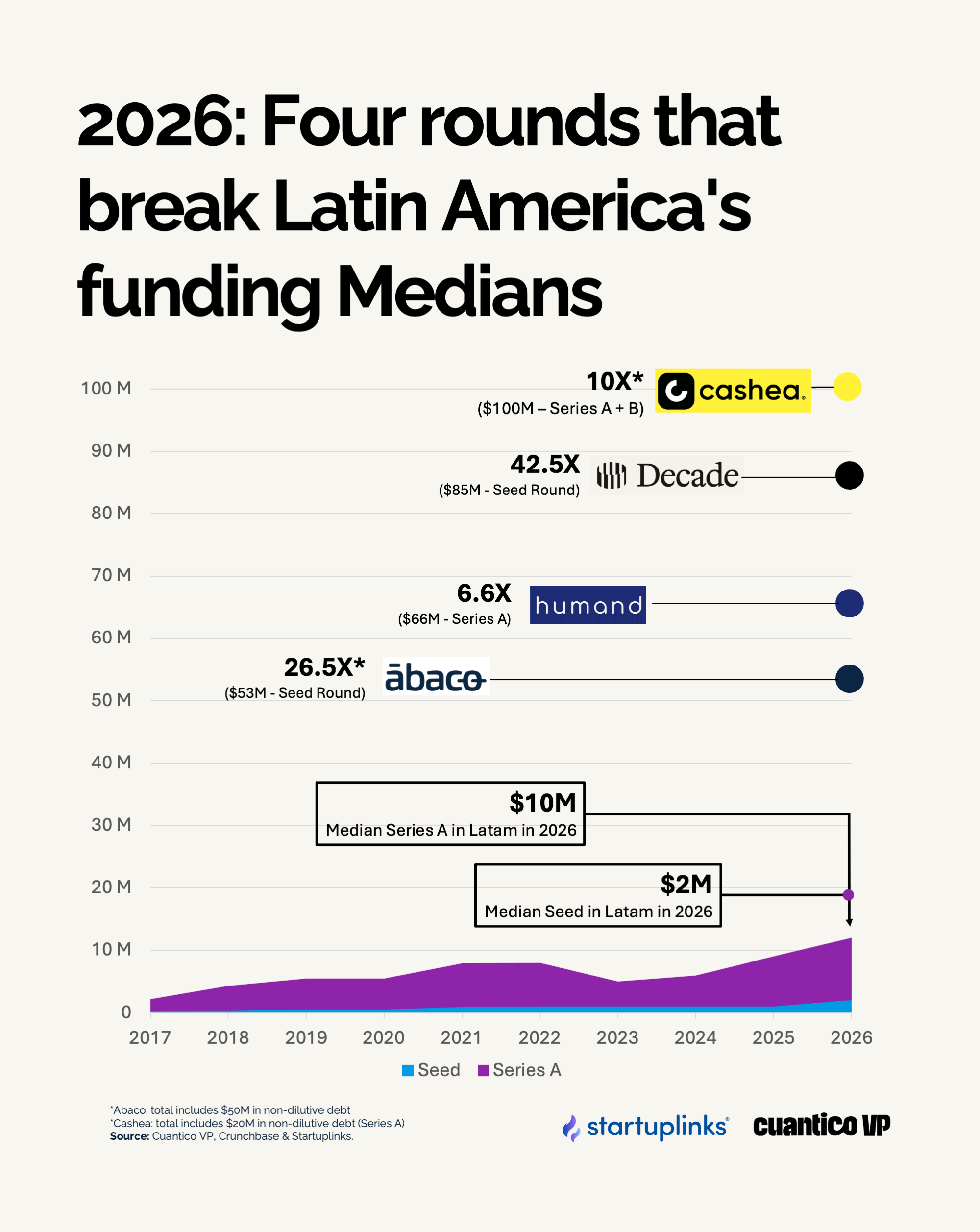
The median seed round in Latin America in 2026 is US$2 million; Decade raised 42.5 times that amount, while Ábaco raised 26.5 times as much. The median Series A in 2026 is US$10 million; Humand raised 6.6 times that figure, while Cashea’s combined Series A and B equals 10 times the regional median for Series A rounds.
Jose Kont, Partner at Cuantico VP, warns of a clear anchor effect stemming from the region’s mega-rounds: “These record rounds are the ones that achieve the greatest visibility in the ecosystem and are beginning to be used as benchmarks in fundraising meetings, pitch decks, and valuation negotiations. When founders cite a US$50M Series A, the risk is that they try to replicate the valuation without replicating the traction.”
Contrast metrics: where capital resides
These rounds do not happen in a vacuum. Data from Cuantico VP’s Latin America VC Report 2026 show that the geographic and sectoral concentration of regional capital remains the rule rather than the exception—and that Venezuela is the exception within the exception: capital returning to a market funds avoided for more than a decade because of sanctions and political uncertainty.
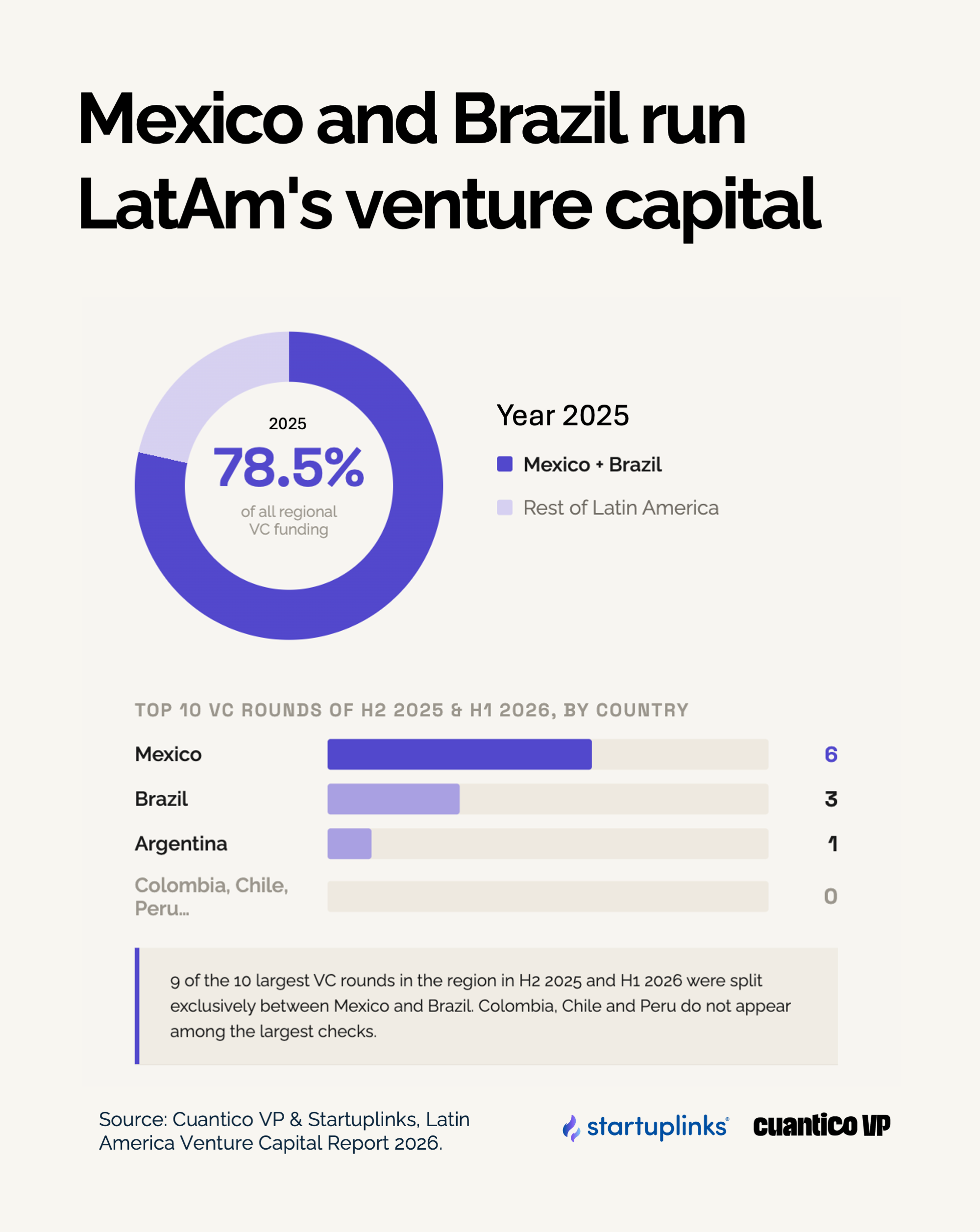
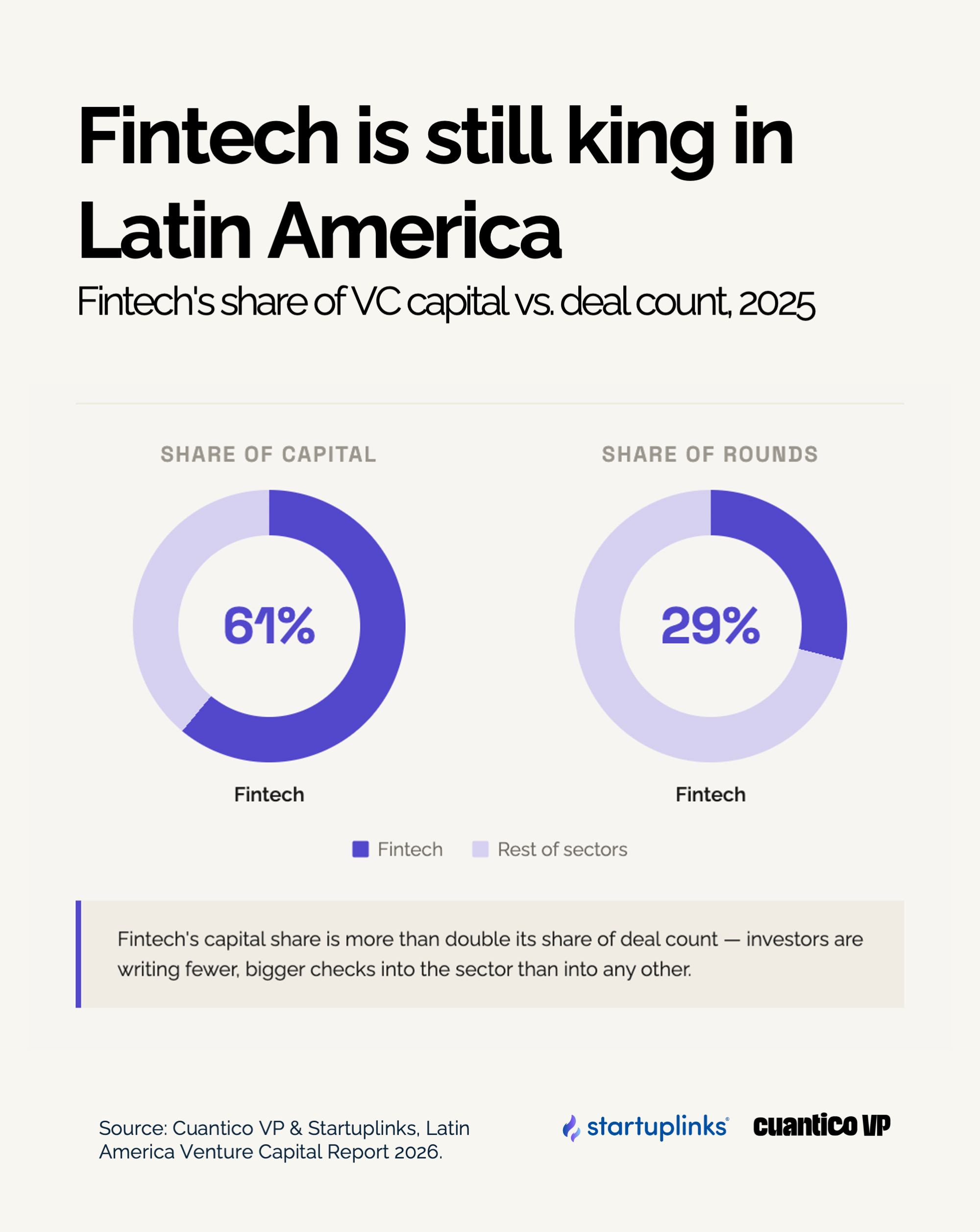
Brazil and Mexico absorbed 78.5% of all capital invested in the region in 2025. Fintech, as a category, captured 61% of capital despite accounting for only 29% of total rounds, evidence that large checks continue to originate primarily in financial services. Ábaco, Decade, and Cashea fit this sectoral pattern—all three are fintechs—while Humand breaks it as an HRtech company based in Argentina rather than in either of the two dominant countries.
What this means for Latin America
- Cashea’s case could open a tactical window for Venezuelan founders, but it is too early to interpret it as a structural reopening of capital flows into the country; it depends on whether the “resilient consumption” thesis holds beyond this transaction.
- There may be greater appetite for hybrid debt-and-equity structures, particularly in credit fintech, replicating the model used by Ábaco and Cashea.
- Brazil and Mexico could further deepen their dominance if these rounds attract more generalist capital from Silicon Valley into those markets, widening the gap with the rest of the region.
- Smaller or higher-country-risk markets, such as El Salvador and Venezuela, may capture specific niches. The challenge will be proving that the model can scale beyond a flagship transaction and does not depend on a temporary political environment.
- Pressure for results will increase: rounds raised on reputation, regulatory infrastructure, or a country-risk thesis—not solely on operating metrics—will need to validate real traction to justify the valuations achieved.
- If this pattern persists, Latin America could consolidate a small tier of “regional champions” financed at a global scale, replicating the concentration dynamic that already exists in the United States through late-stage mega-rounds.
- The structural risk is a “two-speed” region: a handful of startups with access to international dollar capital, while the rest of the ecosystem competes for mid-sized rounds that are increasingly scarce in number, as shown by the decline in total rounds between 2024 and 2025.
- The sustainability of the phenomenon will depend on whether these companies convert the capital they receive into measurable results: assets under management at Decade, customer retention and expansion at Humand, originated credit volume at Ábaco, and deeper consumer credit penetration at Cashea without deterioration in its loan portfolio.
What lies ahead
Decade, Humand, Ábaco, and Cashea have less in common than their headlines suggest. What they do share is that none fits the historical median Cuantico VP has documented over a decade, and all four are arriving in the same year in which the region’s median Series A valuation has begun to rise.
This suggests that 2026 is not simply another year of incremental growth, but a potential inflection point in how Latin American risk is priced—even in its most challenged geographies. Whether this represents a new normal or a temporary window of global liquidity flowing into the region is the question that will define the industry’s next cycle.