This is how Latin America's First AI Unicorn was born

Enter was founded in 2023 in São Paulo by Mateus Costa-Ribeiro, Michael Mac-Vicar, and Henrique Vaz—three former executives from Wildlife Studios, the mobile gaming company that for years was Brazil’s biggest tech success story. That detail matters: they entered the legal world without the weight of legal dogma, bringing a product and scale mindset the sector simply didn’t have.
The bet was to tackle a structural problem that no global player can solve from the outside: Brazil is one of the most litigious countries on the planet, with more than 80 million active cases in its judicial system. The volume of labor and consumer lawsuits faced by companies like Airbnb or LATAM Airlines in that market overwhelms any conventional legal team. Enter turns that volume—which for a human competitor is a cost problem—into an asset: the more cases it processes, the better and more precise its model becomes. Complexity isn’t the obstacle. It’s the product.
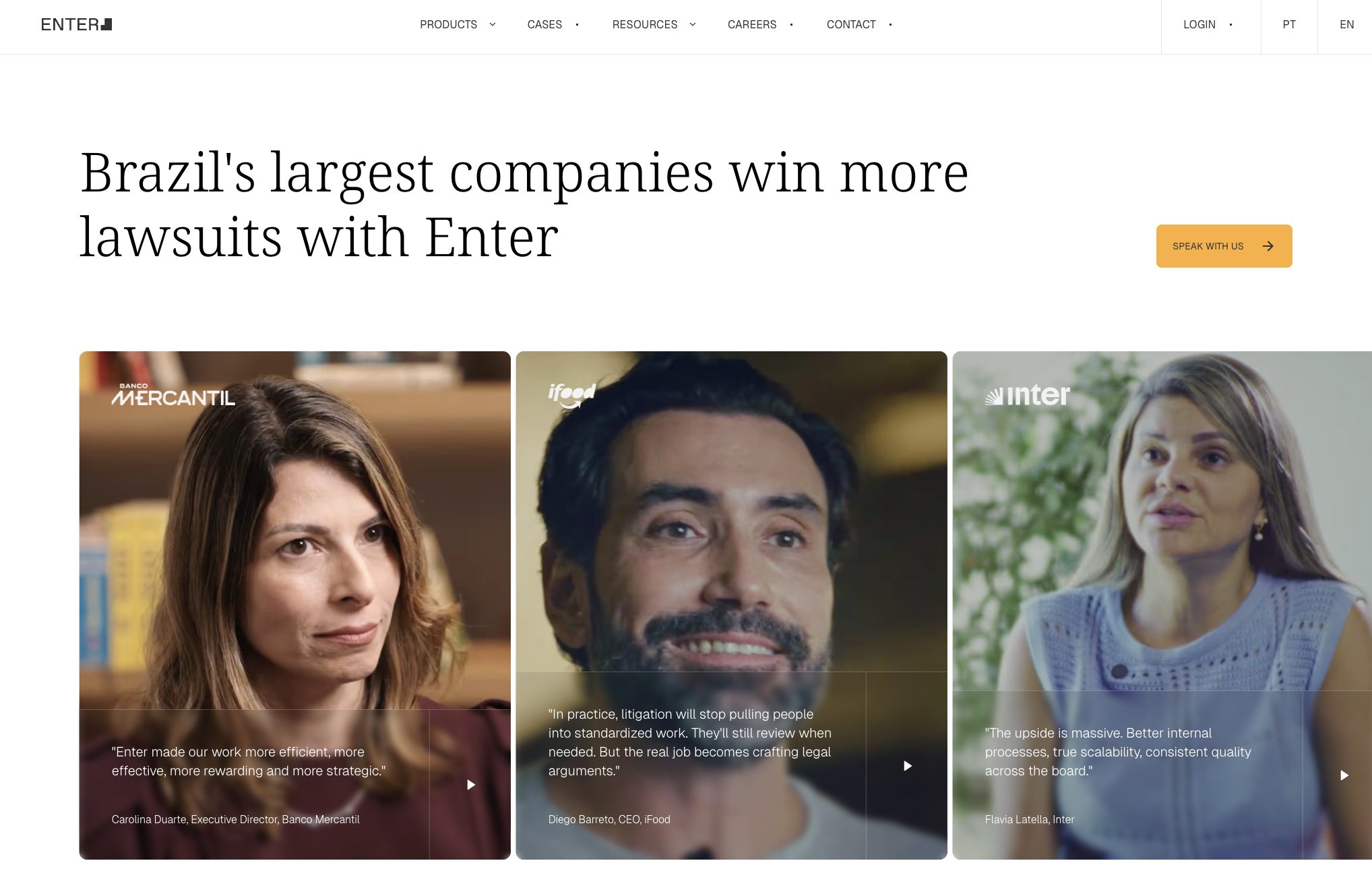
What Enter does is not just automate legal documents. Its technology manages the judicial process end-to-end: it drafts motions, calculates the optimal cost of a settlement, investigates contextual evidence—even weather conditions in a canceled flight claim—and coordinates every step with an AI agent before escalating to a human. Thirty percent of its fees are tied to case outcomes, radically aligning incentives with its clients and turning every successful resolution into model validation.
A funding story that tells its own narrative
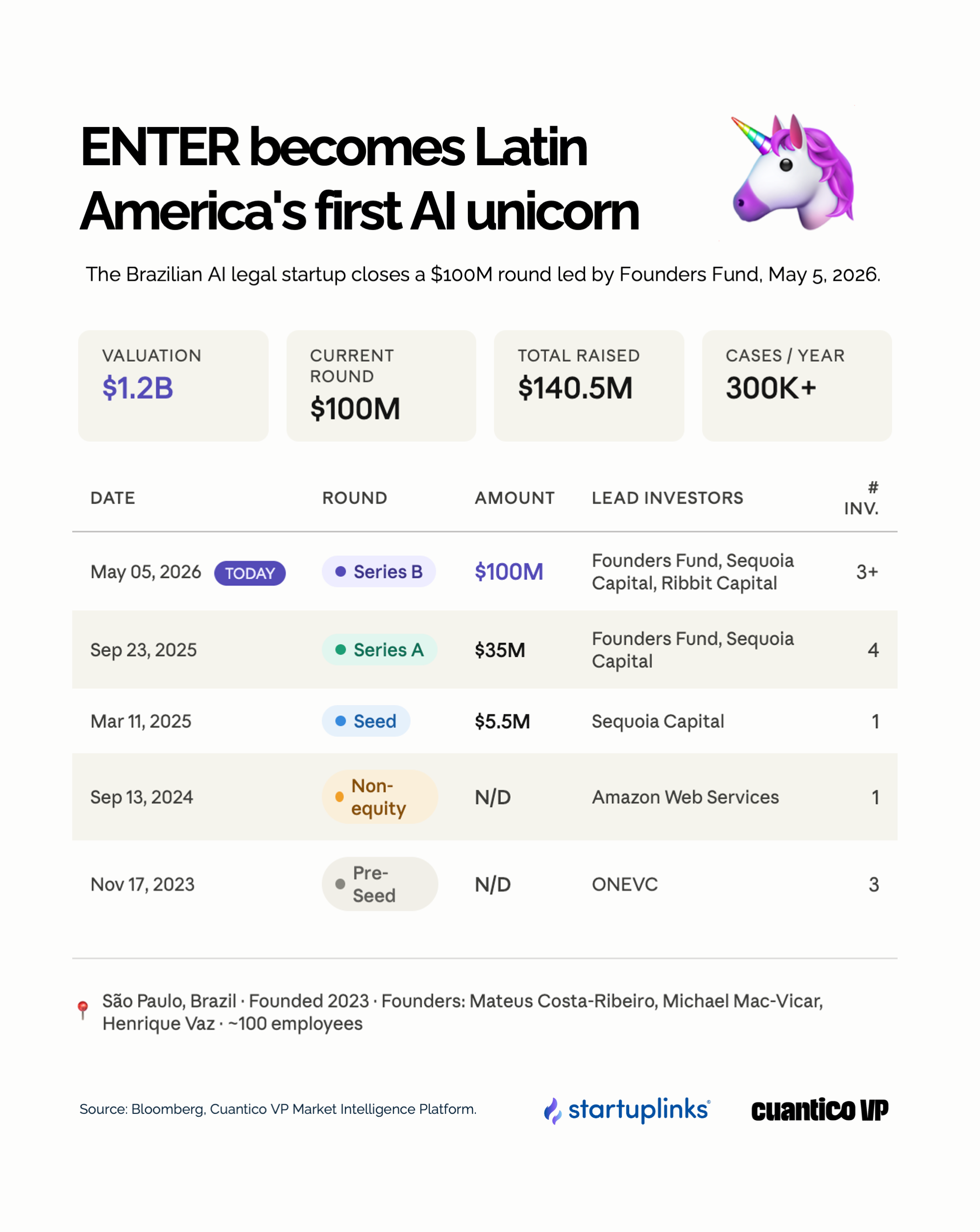
What makes Enter particularly revealing is not just its valuation, but the speed and quality of its capital trajectory.
Pre-Seed · Nov 2023 · ONEVC. The starting point was local. ONEVC, one of the most active venture funds in the Brazilian ecosystem, backed the team at a stage where there was no proven product—only conviction in the founders and clarity of the problem. Three investors participated in this round, whose amount was not disclosed, but it established the foundation of a cap table structure that would remain disciplined throughout the journey.
Seed · Mar 2025 · $5.5M · Sequoia Capital. This is where the story becomes regionally significant. For Sequoia Capital to lead a Seed round solo in a Latin American legal startup is not a common event. Sequoia doesn’t invest in LatAm for geographic exposure—it enters when it identifies the potential for a category-defining company. A Seed round led by Sequoia is, in practice, a signal to the global ecosystem that this company is on its radar for future rounds.
Series A · Sep 2025 · $35M · Founders Fund + Sequoia Capital. In the Latin American context, a $35M Series A was until recently territory reserved for large fintechs—companies with millions of users, complex regulatory infrastructure, and transaction volume metrics that justified checks of that size. For a legaltech startup, this amount was unprecedented in the region, and notable even from a global perspective, where Series A rounds in the legal sector rarely exceeded $15–20M at comparable stages. That Founders Fund—Peter Thiel’s fund, known for backing companies that attack markets others consider intractable—co-led alongside Sequoia signaled more than traction: it signaled thesis. Both funds had already seen enough of the model to double down before the company turned two years old.
Series B · May 2026 · $100M · Founders Fund + Sequoia Capital + Ribbit Capital. The round that turns Enter into a unicorn brings in a new heavyweight: Ribbit Capital, the fintech-focused fund behind Nubank, Brex, and Robinhood. Ribbit’s presence is a telling signal—it suggests the market is beginning to see Enter not just as legaltech, but as financial infrastructure for managing corporate legal risk, a category that directly intersects with Ribbit’s domain. The $1.2B valuation triples that of the previous round. In less than 18 months, Enter went from seed-stage to unicorn.
Structural friction as a moat
Enter is not an isolated case—it is the first scaled validation of a thesis already being quietly executed by other teams across the region. Latin American markets are full of structural frictions that, when processed with AI at scale, generate opportunities that global players cannot easily replicate from the outside.
Brazil’s hyper-litigiousness is just one example. Fragmented credit histories in highly informal economies, heterogeneous tax regulations across countries, the customs complexity of regional trade—all follow the same logic: problems too dense to be solved with generic software, and too large to ignore. An AI-first company that trains its models on this local complexity builds an asymmetrical advantage that is structurally difficult to attack from the outside.
Implications for the ecosystem
The sectors that most clearly follow this pattern are the same ones that have resisted conventional digitization precisely because of their complexity: healthcare, tax and accounting, education, and customs logistics. They all share the same characteristic that made Enter possible—a massive volume of unique cases, market-by-market regulatory heterogeneity, and a wide gap between what exists today and what would be possible if intelligence could process that complexity without friction.
What remains open is whether regional capital has the speed to enter before global funds arrive. In Enter’s case, ONEVC saw it first—and that matters. The next generation of these deals will likely be won or lost at that same stage.