Latin America's Top 10 VC Equity Rounds Q1 2026

A Quarter That Confirmed the Recovery
Latin American startups raised a combined US$1.03 billion across seed- through growth-stage deals in the first quarter of 2026, according to Crunchbase data — a 12% increase year over year. The defining feature of the quarter was a dramatic surge in late-stage and growth capital: US$761 million flowed into later-stage deals, up 158% from Q1 2025 and 203% from Q4 2025. Nearly one-third of all capital deployed went to a single transaction — Kavak's US$300 million Series F — while Mexico overtook Brazil as the leading destination for venture dollars for only the second time in over a decade, raising US$404 million versus Brazil's US$240 million.
The quarter unfolded against a backdrop of structural transformation in the region's venture ecosystem. Full-year 2025 had already signaled a new phase: US$4.126 billion invested across 681 rounds (a 13.8% increase in capital, but the lowest deal count since 2017), confirming the "more money for fewer startups" thesis documented in our Latin America VC Report 2026. Fintech continued to dominate, capturing 61% of total funding with just 29% of deals in 2025. And the arrival — or return — of global firms like Andreessen Horowitz, Sequoia Capital, and Founders Fund in Q1 2026 sent a clear signal: long-term smart capital sees Latin America's best companies as globally competitive bets, not regional concessions.
Below is a closer look at the ten largest equity rounds of the quarter, which together account for roughly US$834 million — over 80% of total Q1 capital — and span seven countries, nine sectors, and a common thread: operational discipline, clear paths to profitability, and the growing role of AI and stablecoins in reshaping Latin American financial and enterprise infrastructure.
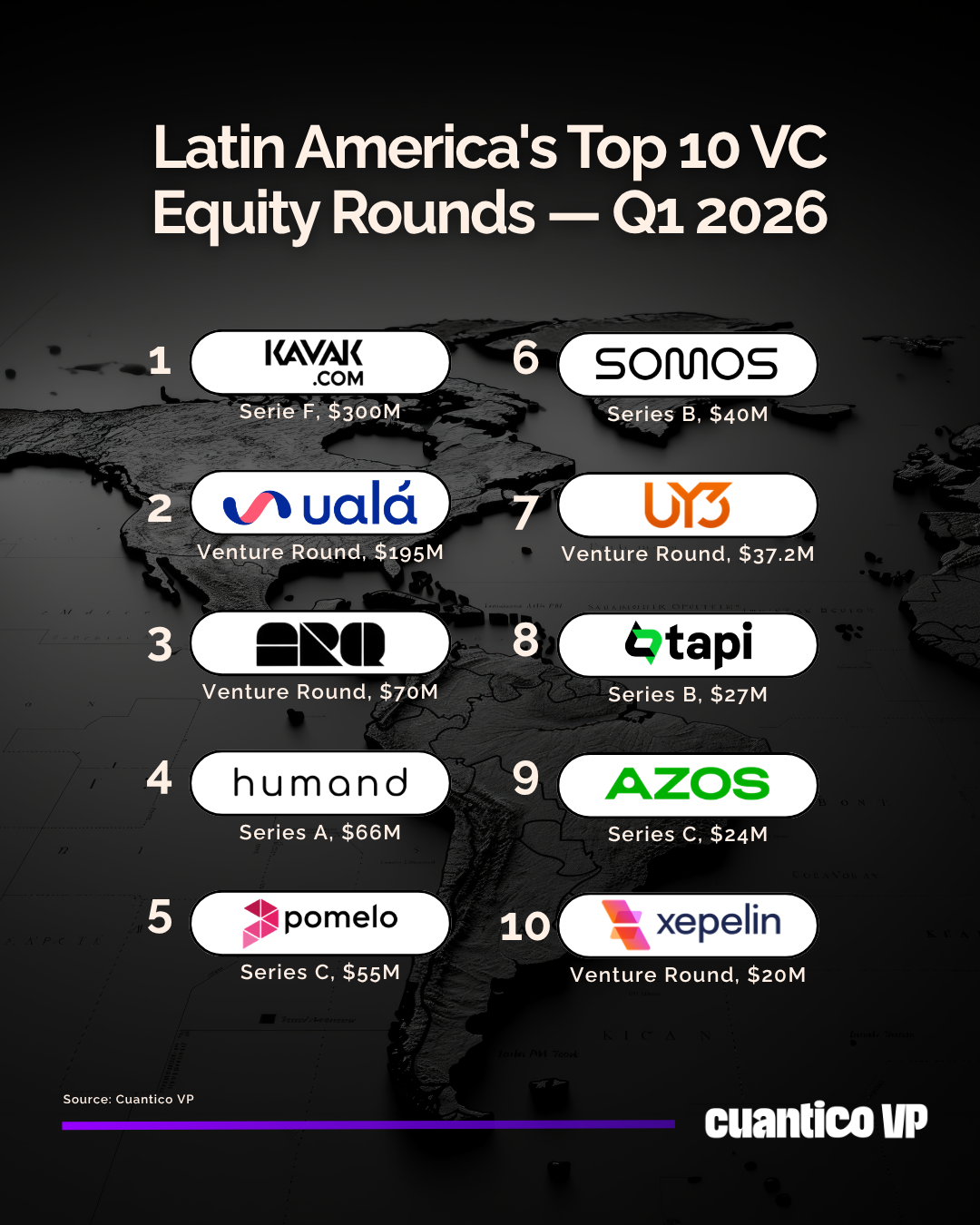
1. Kavak — Series F, US$300M (Mexico)
Kavak is the leading digital platform for buying, selling, financing, and servicing used cars across Latin America and emerging markets. Founded in Mexico City by Carlos García Ottati, the company operates a hybrid model combining physical showrooms with a fully digital platform. The Series F was led by Andreessen Horowitz, which contributed US$200 million through its a16z Growth fund — the firm's largest single-company investment in Latin America and its first in the region from that vehicle — with co-investment from WCM Investment Management, Lingotto, Foxhaven, Galdana Ventures, and Allen & Company.
The round arrives after a significant operational milestone: Kavak achieved its first month of consolidated global profitability in December 2025, driven by strong results in Mexico and meaningful profitability milestones in Chile and the Middle East. In 2025, the company processed approximately 120,000 transactions, representing roughly 40% year-over-year growth. Its financial arm, Kuna Capital, originates US$600 million in loans annually, with fintech growth approaching 100% entering 2026. The valuation exceeds the US$2.2 billion mark set during the April 2025 down round, though the exact figure was not disclosed. With US$1.85 billion in total capital raised, Kavak says it is structurally prepared for a public listing when timing aligns.
2. Ualá — Venture Round, US$195M (Argentina)
Ualá is a digital neobank founded in Buenos Aires in 2017 by Pierpaolo Barbieri, operating through a single mobile app in Argentina, Mexico, and Colombia. The round was led by Allianz X — the strategic investment arm of global insurance giant Allianz — with participation from Stone Ridge Holdings, Tencent, TABLE Holdings, Soros Fund Management, and D1 Capital Partners, valuing the company at US$3.2 billion post-money.
The platform offers digital accounts, debit and credit cards, lending, investments, embedded insurance, and merchant acquiring, serving over 11 million customers. The Allianz partnership has already produced tangible results: in early 2026, the two companies launched fully digital life and personal accident insurance products within the Ualá app in Argentina, generating more than 300,000 quotes within weeks. Ualá holds full banking licenses in all its markets.
In Mexico, active customers have been growing 7% month-over-month since the company obtained its banking license. The platform leverages a proprietary AI-driven credit scoring engine that integrates sociodemographic, transactional, and behavioral data. It has issued more than 9.2 million loans, and over 3 million customers have used its investment tools. In Argentina, nearly one in five adults uses the Ualá platform.
3. ARQ (DolarApp) — Venture Round, US$70M (Mexico)
ARQ, formerly known as DolarApp, is a financial platform built on stablecoin infrastructure that enables users across Latin America to access digital dollar accounts, cross-border payments, international cards, and investment tools. It was founded by Fernando Terrés (CEO), Zach Garman (CPO), and Álvaro Correa (COO), all three former executives at Revolut. The round was led by Sequoia Capital and Founders Fund — both early investors in Nubank — with participation from Kaszek. The capital funds the rebrand from DolarApp to ARQ and the expansion of the product portfolio into wealth management, high-yield accounts, and a premium metal credit card (Prestige).
With over 2 million users and annualized transaction volume exceeding US$10 billion, ARQ operates from offices in New York, Buenos Aires, São Paulo, Kraków, Mexico City, Bogotá, and London. Stripe has recognized the company as one of the most scalable real-world use cases in the stablecoin ecosystem. ARQ targets globally minded Latin American consumers seeking protection from currency volatility and access to international financial services, bridging traditional banking networks with stablecoin-based payment systems through a single, mobile-first platform.
4. Humand — Series A, US$66M (Argentina / U.S.)
Humand is building an AI-powered operating system for the world's 2.7 billion deskless workers — roughly 80% of the global workforce — a segment that enterprise software has historically overlooked. Founded in 2020 in Argentina by Nicolás Benenzon and Gerónimo Maspero, now headquartered in San Francisco, the Series A was co-led by Kaszek and Goodwater Capital, with participation from Y Combinator, Arash Ferdowsi (Dropbox founder), Guillermo Rauch (Vercel founder), Martin Varsavsky, Rajat Suri (Lyft co-founder), and Marcos Galperin (MercadoLibre).
The mobile-first platform integrates over 30 modules — internal communications, leave management, OKRs, attendance tracking, training, benefits — into a single environment with AI agents that process requests, automate onboarding, and answer queries in natural language. Humand serves more than 1.6 million workers across over 1,500 organizations in 51 countries, including Siemens, Home Depot, John Deere, MINISO, Domino's, and OXXO. The company employs 420 people and plans aggressive expansion into the United States, Brazil, and Asia. The round is notable as one of the largest Series A raises by a Latin American-origin company, validated by a roster of prominent founder-investors.
5. Pomelo — Series C, US$55M (Argentina)
Pomelo is a payments infrastructure company offering API-first, cloud-native technology for card issuing, processing, and program management, with direct connections to Mastercard and Visa. Founded in 2021 by Gastón Irigoyen, Hernán Corral, and Juan Fantoni — all three recognized as Endeavor Entrepreneurs — the Series C was co-led by Kaszek and Insight Partners, with participation from Index Ventures, Adams Street Partners, S32, Endeavor Catalyst, monashees, and TQ Ventures. The round brings total capital raised to US$160 million.
Pomelo serves more than 150 clients across Latin America, Central America, and the Caribbean, including Santander, BBVA, Bancolombia, Western Union, Rappi, and Binance. Revenue grew more than 250% over the past two years. The company is now expanding beyond card issuing into stablecoin-denominated cards (USDC), payment tokenization, AI-driven chargeback management, and new real-time payment rails.
For Insight Partners, this marked their first growth equity investment in Latin America, an endorsement of Pomelo's position as critical infrastructure for the region's payments modernization.
6. Somos Internet — Series B, US$40M (Colombia)
Somos Internet is a vertically integrated fiber provider based in Medellín, Colombia, founded by Forrest Heath. The Series B was co-led by Bracket Capital and Ribbit Capital, with participation from Union Square Ventures, Kaszek, Not Boring Capital, Zero Infinity Partners, and Y Combinator.
The company has developed FiberX, a proprietary network architecture inspired by modern data centers that delivers dedicated fiber connectivity directly to each home or business, scales from 1 Gbps to 100 Gbps through simple module swaps, and uses dual fiber links for built-in redundancy. Somos has become Medellín's third-largest internet provider and Colombia's fastest-growing fiber ISP, serving more than 80,000 customers with approximately 6,000 new users added each month. In 2025, revenue tripled and the company reached operational profitability in Medellín, with a customer payback period of 13 months versus an industry average of five years.
Enterprise clients include Mercado Libre and Rappi. The company projects revenue of approximately US$30 million in 2026, plans to more than triple its serviceable footprint in Colombia, and is launching operations in Mexico City as its first international market.
7. UY3 — Venture Round, US$37.2M (Brazil / Uruguay)
UY3 is a digital infrastructure platform for credit and banking services, founded three and a half years ago by three Uruguayan brothers — Tabaré, Querandy, and Caracé Acosta — with decades of combined experience in securitization and credit markets. The company operates as a licensed Sociedade de Crédito Direto (SCD) authorized by Brazil's Central Bank, headquartered in Porto Alegre. The R$200 million was raised from funds managed by Vinci Compass, one of Brazil's largest independent asset managers, directed toward subordinated quotas of FIDCs (credit receivable funds) from partner companies using UY3's platform.
The fintech offers a complete credit stack — from origination through collection — connecting originators (fintechs, banking correspondents, retailers) to capital markets. In 2025 alone, UY3 transacted over R$15 billion through its platform. Its strategic verticals include the "Crédito do Trabalhador" (private payroll-deductible credit for formal workers), vehicle financing via embedded finance, student loans, and credit for hospitals and clinics.
Note: This transaction is classified by some databases as a venture round, though its structure — funding subordinated FIDC quotas rather than direct equity — places it closer to credit infrastructure capital than traditional VC equity.
8. Tapi — Series B, US$27M (Argentina / Mexico)
Tapi is the leading payments and collections network in Mexico, with additional presence in Argentina, Chile, Colombia, and Peru. Founded in Buenos Aires in 2022 by Tomás Mindlin, the Series B was led by Kaszek, with participation from Endeavor Catalyst and Latitud, bringing total capital raised to over US$60 million.
Tapi's infrastructure connects more than 20,000 service companies and 70,000 physical locations, processing over 250 million transactions per year for a volume exceeding US$6 billion. The platform enables cash deposits and bill payments through retail chains such as OXXO, Walmart, 7-Eleven, and Tiendas 3B, with integrations serving Nubank, Mercado Pago, Santander, Banamex, and HSBC.
In 2025, following its acquisition of the Arcus assets from Mastercard, Tapi grew revenue tenfold and reached profitability. Its flagship product, tapipay, fully automates recurring collections for SMEs, insurance companies, and financial institutions through a single API. Mexico accounts for over 90% of transactions, and the company plans to triple its current volume in 2026 while expanding into underdigitized sectors such as education, healthcare, and regional insurance.
9. Azos — Series C, US$24M (Brazil)
Azos is a Brazilian insurtech focused on individual life insurance, founded in 2020 in São Paulo by Rafael Cló, Renato Farias, and Bernardo Ribeiro. The Series C was co-led by Kaszek (an investor since the seed round) and Kevin Efrusy (an early Facebook investor). The company operates under the MGA (Managing General Agent) model in partnership with Excelsior Seguros, which allows it to design products, manage customer experience, and price risk without holding its own insurance license.
Azos manages over US$21.1 billion in policies under management, representing more than 1% of Brazil's individual life insurance market — a sector dominated by Bradesco and Prudential. Its platform already approves 30% of policies in seconds through AI-powered underwriting, with a target of reaching 50% by year-end. Azos also processes claims in hours rather than the industry-standard weeks and is building AI tools to help its 11,000 partner brokers increase sales. Revenue doubled in 2025.
The funding is earmarked for scaling AI across underwriting, claims processing, and broker support. The company's ambition, as stated by its CEO, is to replicate in the life insurance market what Nubank accomplished in banking.
10. Xepelin — Bridge Round, US$20M (Chile)
Xepelin is a Chilean fintech providing financial services to small and medium-sized businesses, founded in 2019 and operating primarily in Mexico and Chile. The US$20 million bridge round was led by Nazca Ventures, valuing the company at approximately US$400 million — a decline of over 40% from its previous US$720 million valuation.
The platform functions as a "digital CFO" that integrates invoice financing (accounts receivable), working capital loans, automated B2B payments, and real-time financial information for SMEs. Since its founding, Xepelin has served more than 70,000 companies and generates close to US$100 million in annual revenue. The capital supports efforts to secure a Sofipo license in Mexico, a regulatory approval that would allow Xepelin to significantly scale its lending operations in that market. Its AI-based risk model evaluates transactions to finance SMEs that have historically lacked access to formal credit.
With US$587 million in total capital raised (including debt facilities), Xepelin remains one of the most capitalized players in Latin America's B2B fintech ecosystem. The down round reflects the broader repricing of growth-stage companies across the region, even among those with substantial revenue and market presence.